






There is an old adage that a picture paints a thousand words. In the scientific community, the same can be true of a single sentence and not always in a good way. Complex biological mechanisms can be distilled into a few choice words like ‘gene expression’ or ‘photosynthetic efficiency’. By stringing a few of these together, you can reduce a lengthy explanation into a single sentence.
Unfortunately when presenting under time constraints, it is sometimes necessary to do this, to ensure that you have a chance to cover both technical explanations and trial data. It can be a difficult balancing act. However, if the mechanisms behind why a product works are not understood, that data can become just another forgettable set of numbers.
I recently presented at Turf Science Live Ireland I used the phrase: “The product upregulates genes responsible for priming the plant to respond to drought stress.” In my mind, I was backed by cutting-edge data on gene activity and solid trial results. But after an audience member asked me to explain how genes affect a plant’s response to stress. I realised then that two phrases in that statement were doing a massive amount of heavy lifting: ‘upregulating genes’ and ‘priming’. Each was doing the work of an entire paragraph.
This article is an attempt to give context to that sentence and delve deeper into the science of biostimulants.
The Sceptic’s View
Historically, I have always been a biostimulant doubter. It wasn’t that I didn’t think there was a positive effect, but rather that I felt the products were over-hyped. I categorised biostimulant benefits into three main areas:
- Carbohydrates: Why not just use molasses?
- Micronutrients: These are very rarely a deficiency in managed turf.
- Hormones: On this last point, I was particularly sceptical. A plant produces its own hormones to respond to stress, so why do we need to tamper with them?
It is this final point in particular that has forced me to reconsider. Solid data helped, but fundamentally understanding the mechanism is what clinched it for me.
Upregulating Genes
To understand this, we need to look at the role genes play in stress response. Think of each gene as a page of an instruction manual on how to manage stress. Each page or gene gives us instructions on how to build compounds such as proteins or pigments crucial for carrying out different tasks within the plant. During unstressful times, the manual is open to pages covering production of compounds for daily business such as growth and photosynthesis.
When stress hits, some of those ‘normal growth’ pages are closed; this is what we mean when we say genes are ‘downregulated’. The plant then moves to the pages that help it survive stress, such as the instructions to close stomata, stop leaf growth or produce protective pigments. Hormones are essentially the signals that tell the plant which pages to open or close (Genes to be, ‘upregulated’ or ‘downregulated’.)

Figure 1: Ai Generated image
Priming
To understand priming, we need to look at ‘epigenetics’ or plant memory. Plants do not have memories in the traditional sense, but when a plant experiences stress, it undergoes lasting chemical changes. This means it does not return to its original state, instead, it remains prepared to respond more quickly if the stress returns.
Using the instruction manual analogy again: if a plant experiences drought, it responds by placing bookmarks in the pages relevant to drought stress. When the stress hits again, the plant doesn’t have to hunt for the right instructions. It can rapidly close its stomata and enact its defences. Acting quickly saves plant tissue and improves recovery rates. The first drought event causes the most damage, but it prepares the plant for future dry conditions. This ‘stress memory’ or priming can last for hours, days, or even months.

Figure 2: Ai Generated image
Bringing it back to Biostimulants
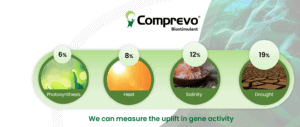
This brings us back to my claim about Comprevo, the Syngenta biostimulant I discussed at TSL Ireland: “The product upregulates genes responsible for priming the plant to respond to drought stress.”
Hopefully, this statement now makes more sense. We apply the product to give the turf a ‘memory’ of stress before that stress hits, allowing it to place the relevant bookmarks in its genetic manual. When the heat arrives, the plant is primed and ready to act efficiently to protect itself. This is why application timing, applying before the stress hits, is so critical.
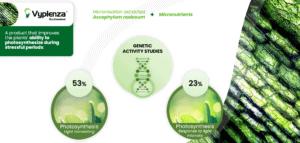
By identifying the specific genes the product affects, we avoid the ‘scattergun’ approach of applying a biostimulant product and simply hoping for the best. Furthermore, this allows for a level of quality control rarely seen in biostimulants. By testing the level of gene regulation, we can ensure consistency. While extraction techniques vary wildly, being able to quality-test a biostimulant at the genetic level is truly ground breaking.
For the first time, we can see exactly what stresses we are priming for and when in the season we need to apply. This opens up the opportunity for a biostimulant programme, switching products through the season to target specific stress periods. There is a saying that a broken clock is right twice a day; this is the same with using one biostimulant throughout the season, at some points in the year, it’s probably working. However, by identifying the specific genes the product effects, we can target it to points of the season when it will be most effective and then switch to a different product when stresses change.


Dinesh
Great blog explaining a topic that many growers overlook when using growth regulators. The discussion around plant recovery and subsequent growth patterns adds a valuable perspective. Companies like Dhanuka Agritech are actively working with crop management solutions, so practical field examples would be an interesting addition to this discussion.
2026-06-02 11:31:10